
If I were superstitious, at some point I would’ve thought Allison was not meant to travel to Colombia that weekend: first, she couldn’t take the original flight she had scheduled to Bogota; then, she was stuck with one of my suitcases because somehow we thought it’d be a good idea for her to save me some trouble and money by carrying it herself. Finally, a very last-minute flight booked the next morning had her rushing to the airport at dangerous speeds with little chance of making it to the gate before the plane took off.
But I’m not superstitious.
And Allison made it to my country on what would become her first South American trip, a trip that ended up being an absolute success.
With only forty-eight hours available to taste the fervor of Colombian Christmas, Allison couldn’t have arrived at a better time: Noche de Velitas, or Candle Night, a special celebration in which Colombians across the country light colorful candles on streets and balconies in what has become the unofficial start to the holiday season. Music is played in every house, neighbors share drinks and hugs, and impromptu parties take place on the streets till the early hours of the following day.
Allison immersed herself in this right after leaving the airport because by the time we made it to my neighborhood, dancing and joy impregnated the atmosphere despite the late hour. By midnight we were sitting on some chairs in the middle of a closed road as some friends partied and offered us drinks. Occasional fireworks lit up the sky, their detonations blending with popular Christmas music blasting through gigantic speakers placed on sidewalks. If she was tired after the long day of traveling, she didn’t show it; Allison took in the festivities with a big, curious look, probably trying to digest this Colombian insanity of dancing out there in the cold while having barbeques or shots of aguardiente (a popular local drink.)
But the true highlight of her stay came the next day when we embarked on a Christmas lights tour that took us to Boyacá, one of Colombia’s thirty-two departments. We booked the experience with my family and Allison happily joined us without really knowing what to expect. A bus with some thirty people left Bogotá at 2 p.m. to immerse in the rural peacefulness so distinctive of Boyacá. By 5 p.m. we had our first stop to get a snack in Ventaquemada, a town known for its tasty and unbeatable arepas.
Next came Corrales, a municipality sieged by countless vehicles arriving at the official Christmas Lighting ceremony starting at 8 p.m. A roaring celebration unfolded at the town square with orchestras, typical Boyacá music, and firework displays attracting an ever-growing crowd full of excitement. The plaza was packed, yet somehow people kept arriving, especially when a countdown began for the lighting of the main church in town. By the time we left, the party was just beginning, even though Allison was already fascinated by the joyful environment around us.
At 10 p.m. we arrived at an iconic town renowned for its crafts and wool fabrics. Streets around Nobsa’s main square offered a seemingly infinite array of shops and stands where it was practically impossible to leave empty-handed. The church sparkled with its Christmas illumination, while a pathway formed by shining decorations guided tourists through the main avenue, which had an effervescent activity in every little store and restaurant.
Tibasosa wasn’t as hectic, but its holiday spirit remained very much alive at midnight thanks to its well-lit cathedral or the Tibasosa sign in the middle of the town square. It was the perfect location for some pictures. The rather quiet atmosphere led us to believe that people were on their way home and we would find our next stop deserted. We were so wrong.
Puente de Boyacá is a national monument where a battle of historic proportions sealed the independence of Colombia from Spanish rule in 1819. While no fighting occurred when we arrived there at 3 a.m., it truly felt like the epicenter of a colossal commotion reuniting an impossible amount of people considering the late (or very early) hour. It was freezing, a kind of cold that penetrates your clothes and skin, a kind of cold I had never experienced in my country before. But the shocking part was the never-ending lines of people congregating wherever possible to admire the Christmas lights sown on little hills around the bridge.
Allison’s shock was evident. Who in their right mind went out there under such temperatures to admire holiday decorations at 3 o’clock? What’s more, how come everyone seemed so happy and alive? Kids ran or rolled down the hills, families took pictures under green and red light bulbs, and new visitors kept arriving nonstop. We went to a packed shop seeking a hot beverage, and when we finally got it, we just stood outside at about 4 a.m. contemplating with shivering hands the marvelous view before us. It was surreal.
At long last, the time came for us to go back to Bogotá. Every bus ride from town to town was used to nap as much as possible, and this last drive was not the exception. We made it to the starting point from the day before shortly after 6 a.m., in sync with sunrise. But while my family, red eyes and sleepiness painted all over their faces, rejoiced in the idea of taking a taxi to go home, Allison and I got on an Uber for our final, perhaps most important stop: Monserrate.
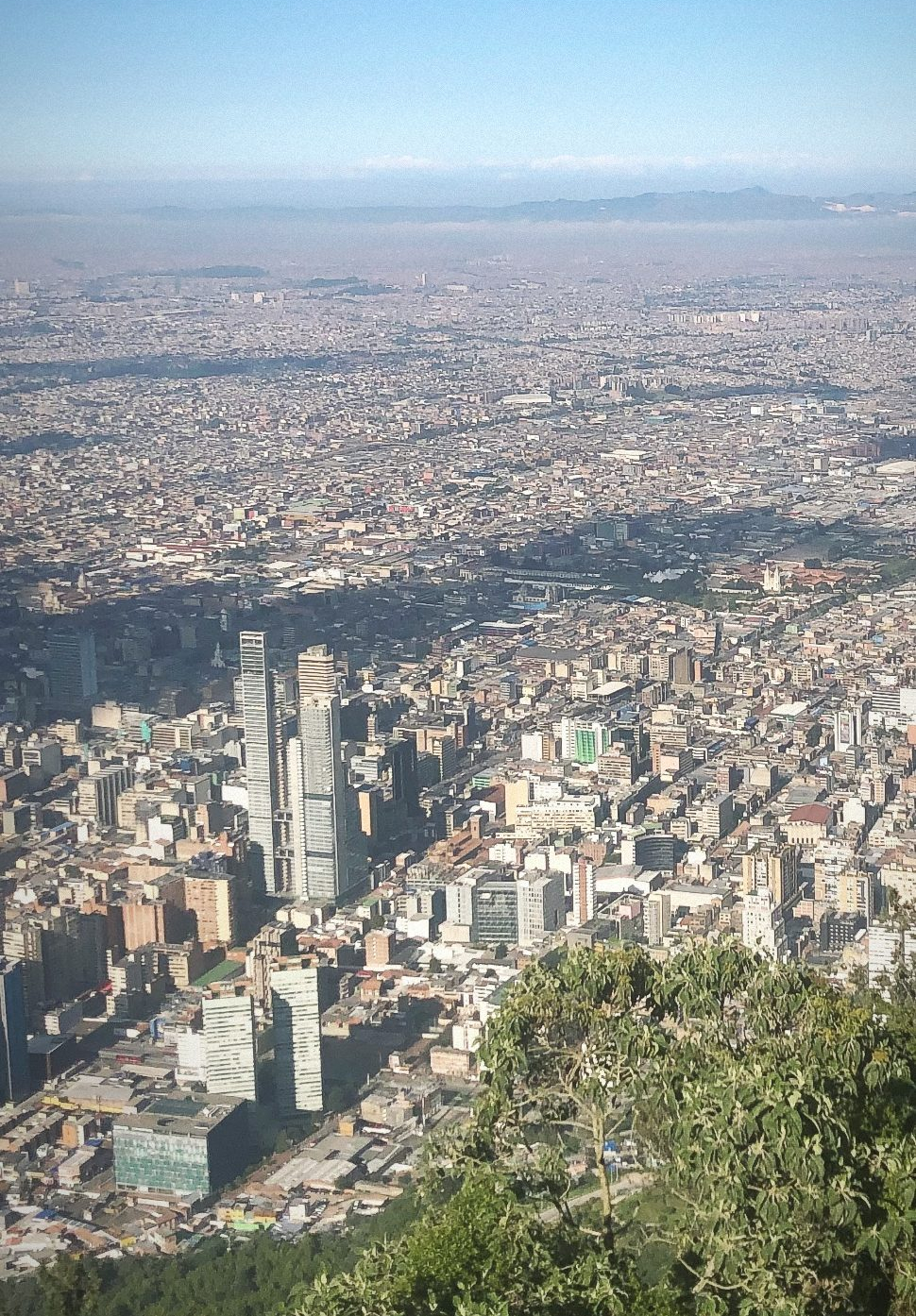
On Sunday, December 9 at 8:40 a.m. I took the first selfie of Allison and me on top of the most iconic sight in Bogotá, a colossal hill overlooking Colombia’s capital with its 3,152 meters above sea level. Behind us, the popular church built at the summit in the 17th century stood impassible as sunshine warmed us after our cold early hours. In less than twelve hours Allison would be on her way back to the U.S., but for the time being her only preoccupation was to take the best possible shots of the church and the city below us. We had completed more than eighteen hours going from place to place but we still had a last bit of gas in our tanks to go to Plaza de Bolívar, another historical site near Monserrate where we contemplated the core of the Colombian government.
Over the years, Allison has taken more trips than I can remember, but every time we go for a coffee and a conversation, she reminisces about the splendid time she had in my hometown, about how much she longs to go back. An eighteen-hour tour culminating on a hill 3,000 meters above sea level might sound like the most absurd idea ever, but when you have a phenomenal friend like Allison, it can only become the most extraordinary, unforgettable experience.
The Eighteen-Hour Pilgrimage to Monserrate
5–7 minutes
 Voyassitude
Leave a comment